
Your car gets totaled. The insurance company sends a settlement offer and you look at the number, frown, and wonder how they got there. Then the loan statement arrives and you realize there is a gap, sometimes a sizable one, between what the insurer is paying and what you still owe. What most drivers do not realize is that this sequence of events can trigger a chain of financial consequences that goes well beyond the immediate claim, and one of the most overlooked is the impact on your credit. A total loss credit score impact is real, specific, and preventable if you know what to watch for.
Why a Total Loss Can Threaten Your Credit in the First Place
A vehicle collision, by itself, does not show up on your credit report. The accident is not a financial event. What affects your credit is everything that happens afterward, specifically how the gap between what you owe and what you receive gets handled.
When an insurer pays out an actual cash value that falls short of your remaining loan balance, you are left with a deficiency. If you have GAP insurance, that deficiency is covered and the problem largely disappears. If you do not, that remaining balance becomes an unsecured debt you still owe your lender, and that debt behaves like any other unpaid obligation. Miss it, ignore it, or assume the insurer handled it, and the consequences show up on your credit history.
The Four Specific Ways a Total Loss Can Hurt Your Credit
1. Loan Deficiency That Goes Unpaid
This is the most direct and most damaging scenario. You owed $24,000 on your vehicle. The insurer paid $19,500 based on their ACV calculation. The lender applies that amount and the remaining $4,500 sits on your account. If you do not pay it and the lender does not communicate clearly about what is still owed, that balance ages, becomes delinquent, and eventually gets reported to the credit bureaus as a late or missed payment.
Depending on how long it goes unaddressed, a deficiency balance can result in a 30-day late mark, a 60-day late mark, a charge-off, or even a collections account, each one more damaging than the last. A single serious delinquency can drop a credit score by 80 to 120 points depending on the profile of the account holder.
2. A Charge-Off on the Auto Loan
If a lender decides the deficiency is uncollectible, they may write it off as a loss on their books. This is reported to the credit bureaus as a charge-off, which is one of the most damaging notations that can appear on a credit report. A charge-off signals that the creditor has given up on collecting the debt through normal channels. The debt itself does not disappear. Lenders frequently sell charged-off balances to collection agencies, which means a second negative entry then appears on your report from the collections account.
3. Repossession After a Delayed Total Loss Decision
This scenario is less common but worth knowing. When a total loss determination takes time, especially in complex claims or disputes, the vehicle may sit undriveable while the loan payments are still due. Some drivers stop making payments on a car they cannot drive and cannot sell, assuming the claim will resolve it. If the claim takes longer than expected and payments lapse, the lender may initiate repossession procedures. A repossession is among the most severe negative entries a credit report can carry and remains on record for seven years.
4. Loss of Credit Mix and Account History
This one is subtler but real. An auto loan is an installment account, and having a healthy mix of account types (installment and revolving) is a positive factor in credit scoring models. When a total loss closes your auto loan, especially a long-standing one with a strong payment history, you lose that installment account from your active profile. If you do not replace it promptly with another installment account, your credit mix narrows and your average account age can shift depending on the rest of your credit history.
How Loan Deficiency and GAP Coverage Interact
Understanding where the money flows helps clarify where the risk enters the picture.
| Scenario | What Happens to the Loan | Credit Risk |
|---|---|---|
| ACV covers full loan balance | Loan paid in full and closed | None |
| ACV falls short, GAP insurance present | GAP covers the deficiency, loan closed | Minimal to none |
| ACV falls short, no GAP coverage | Deficiency balance remains on open loan | High if unpaid |
| Low ACV offer accepted without dispute | Larger deficiency, higher residual balance | High if unpaid |
| ACV disputed and increased via appraisal | Smaller or no deficiency | Reduced or eliminated |
The takeaway from that last row is the one most drivers miss. The size of the deficiency is directly tied to how accurately the vehicle was valued in the first place. A settlement that is $3,000 below your car's real market value does not just mean a smaller check. It means a $3,000 larger unpaid balance sitting on a loan account that can damage your credit if it goes unresolved.
This is one of the clearest reasons why disputing a low ACV offer matters beyond the settlement itself. Our breakdown of how insurers calculate total loss value explains the mechanics behind ACV and where the undervaluation typically comes from.
What to Do Immediately After a Total Loss to Protect Your Credit
Confirm the Loan Payoff Amount Before Accepting Any Settlement
Call your lender and request the current payoff amount, which is different from your remaining balance because it factors in any prepaid interest or fees. You need to know the exact number that will close the loan. Compare that number directly against the insurer's ACV offer. If there is a gap, you know what you are dealing with before you sign anything.
Do Not Assume Payment Stops Your Obligation
When the insurer issues a check to your lender, follow up in writing to confirm the loan has been paid in full. Get written confirmation from the lender that the account is closed with a zero balance. Do not rely on verbal assurances. If the insurer's payment left a residual balance, you need to address it before the next billing cycle generates a late-payment trigger.
Dispute a Low ACV Before Accepting It
You are not required to accept the first offer. If the ACV the insurer calculated is lower than what your vehicle was actually worth, disputing it with an independent appraisal can close some or all of that deficiency before it becomes your problem. The actual cash value calculation used by insurers frequently undervalues vehicles, particularly those with lower mileage, strong maintenance history, or market conditions that have shifted since the vehicle was purchased.
Check Whether Your Policy Includes GAP Coverage
Review your declarations page. If you financed or leased through a dealership, GAP coverage may have been included in the deal or rolled into your loan. If your auto insurance policy includes it, confirm it with your carrier in writing. If you do not have it and the settlement is short, you have no backstop.
Monitor Your Credit Report After the Claim Closes
Once the total loss claim settles, pull your credit report within 60 days and verify how the auto loan account is reported. It should show as paid in full and closed. If it shows an open balance, a late payment, or any derogatory notation, dispute it with the credit bureau immediately. Under the Fair Credit Reporting Act, you have the right to dispute inaccurate information and require verification.
The Undervalued Settlement Problem and Its Credit Consequences
Insurers use proprietary valuation tools like CCC One and Mitchell to generate their ACV calculations. These tools are built for efficiency at scale, not for accurately reflecting the specific value of your specific vehicle in your specific market. They frequently undervalue well-maintained vehicles, underestimate option packages, and use comparable sales that do not genuinely match your car's condition and trim level.
When you accept a settlement offer that does not reflect your vehicle's real market value, you are absorbing two costs at once. The first is the immediate shortfall between what you were paid and what the car was worth. The second, if you carry a loan, is the enlarged deficiency that flows directly from that suppressed ACV number.
An independent appraisal is not just about getting more money. It is about getting an accurate number so that every downstream financial decision, including whether a deficiency exists at all, starts from a correct foundation. Our guide on documenting your vehicle's value covers the evidence you need to support a credible ACV dispute.
When the Total Loss Process Also Affects Your Ability to Finance a Replacement
One more consequence that does not get enough attention: when a total loss claim closes while an auto loan deficiency remains unresolved, it does not just affect your existing credit history. It affects your ability to finance the replacement vehicle you need to get back on the road.
Lenders evaluate your credit profile before approving a new auto loan. If your report shows a recent late payment, an open delinquency, or a still-active auto loan that has not been formally closed, your application may be declined or approved only at a significantly higher interest rate. The total loss that already cost you money on the settlement now costs you again on the financing of your next car.
This is why resolving the original claim correctly, and quickly, has compounding financial value. Every dollar recovered through a proper ACV dispute reduces your deficiency, shortens the path to a clean credit profile, and improves the terms you can secure on your next loan. Our full guide on total loss settlements when financing is involved covers the full sequence of what to do and in what order.
Get Your Vehicle Appraisal Before Accepting a Settlement
A low ACV offer does not just reduce your check. It can leave you with a loan deficiency that damages your credit long after the claim closes. Get an independent appraisal and know what your car is actually worth.
Get Your Free QuoteSave this article as a PDF to share with your lender, attorney, or claims representative.
Download PDFFrequently Asked Questions
Does a total loss automatically hurt my credit score?
Not automatically, no. The accident itself is not a credit event. What hurts your credit is what happens with any remaining loan balance after the settlement. If the insurer's payout covers the full loan balance and the account is closed with a zero balance, there is no direct credit impact. The risk enters if a deficiency exists and is not promptly resolved.
How long does a total loss deficiency stay on my credit report if it goes to collections?
A collections account can remain on your credit report for up to seven years from the date of the original delinquency. If the account is charged off and then sold to a collections agency, you may see two separate negative entries on your report for the same underlying debt. Addressing the deficiency before it reaches that stage is significantly easier and less damaging.
What if I cannot afford to pay the loan deficiency after a total loss?
You have a few options. First, dispute the ACV offer with an independent appraisal. A higher settlement may reduce or eliminate the deficiency. Second, contact your lender and ask whether they will accept a negotiated settlement for less than the full balance. Third, if your financial situation is severe, consult with a consumer credit attorney about your rights. Do not ignore the balance. The longer it goes unaddressed, the more options close off.
Can an independent appraisal really change the size of a loan deficiency?
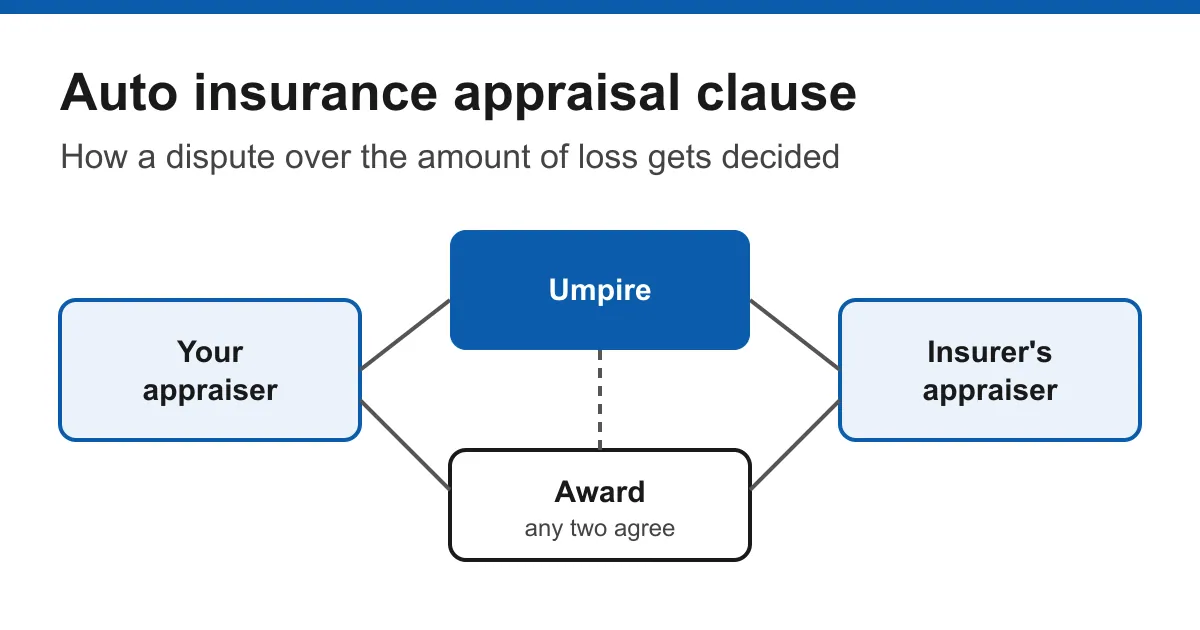
Yes. The deficiency is simply the difference between what the insurer pays and what you owe. If an independent appraisal produces a higher ACV that the insurer accepts or is compelled to accept through the appraisal clause in your policy, the settlement payment increases and the deficiency shrinks accordingly. On a vehicle that was meaningfully undervalued, this can eliminate the deficiency entirely.
Does GAP insurance cover the full deficiency every time?
Not always. GAP insurance covers the difference between the insurance payout and the remaining loan balance, but most GAP policies exclude certain items such as past-due payments, fees rolled into the loan, extended warranties financed into the principal, and similar additions. Read your GAP policy carefully before assuming the entire deficiency is covered. The gap between what GAP covers and what you owe is yours to pay.