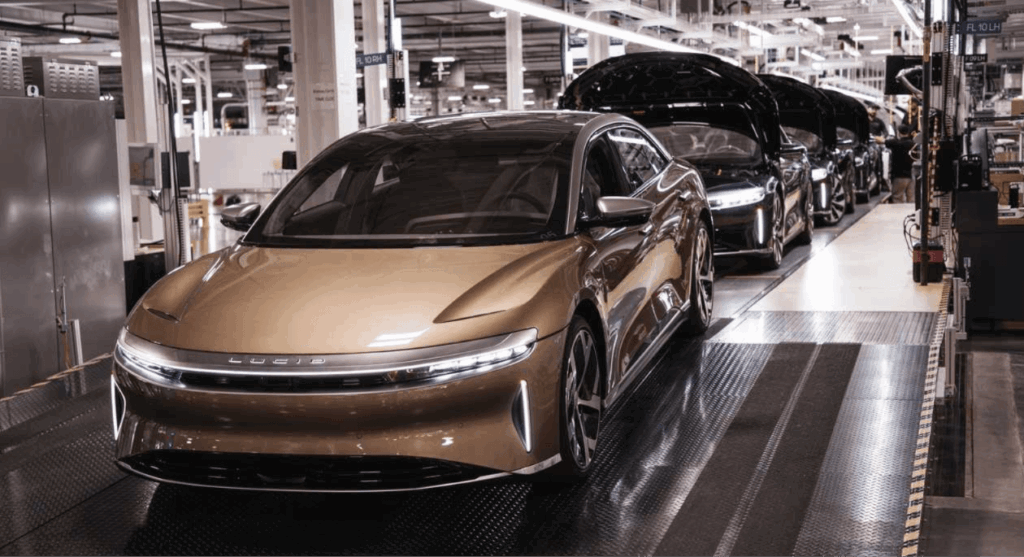

Lucid Motors cut 18% of its U.S. workforce in June 2026, roughly 1,500 employees, just four months after cutting 12% of its staff in February. That is two rounds of layoffs inside a single year, at a company that has never turned a profit, under a CEO who took the job barely three weeks before ordering the cuts. It is a rough stretch for one company, but it is also a useful window into a much larger question: what happens to an automaker whose entire business is built on a single bet that the market has not validated yet.
Here is what happened at Lucid, how it compares to the rest of the EV-only field, and what the pattern says about where the electric vehicle market actually stands in 2026.
What Actually Happened at Lucid
Lucid announced on June 22, 2026 that it would cut approximately 18% of its U.S. workforce, affecting full-time employees, contractors, and hourly production workers. The company also eliminated the second production shift at its Casa Grande, Arizona factory. The cuts are expected to generate annualized savings of roughly $158 million and will cost the company around $32 million in severance payments.
This was the first major move by new CEO Silvio Napoli, who formally took over on June 1 after more than a year of interim leadership under Marc Winterhoff, who departed the company the same day the layoffs were announced along with the elimination of the COO role entirely. Napoli’s background is notable in itself: he spent his career at Schindler Group, the Swiss elevator and escalator manufacturer, an unconventional resume for someone now running an EV startup.
Lucid framed the restructuring as an effort to “simplify the company, sharpen execution, and position Lucid to become more competitive over time.” In plainer terms, the company delivered just 3,093 vehicles in the first quarter of 2026 and still has not found a path to profitability, years after its first product launched.
Lucid Is Not an Isolated Case
The EV-only startup category has a difficult track record, and it is worth looking at the full scoreboard rather than treating Lucid’s situation as an outlier. Fisker filed for bankruptcy in 2024 after burning through cash trying to scale its Ocean SUV, and a bankruptcy judge later approved liquidation of its remaining inventory. Canoo, once valued at $2.4 billion after a SPAC merger without having sold a single vehicle, filed for Chapter 7 bankruptcy and ceased operations entirely. Electric Last Mile Solutions, Lordstown Motors, and Proterra all went through some version of the same story: ambitious product plans, heavy cash burn, and an inability to reach the volume needed to survive as a single-product electric vehicle company.
The pattern across nearly every failed or struggling EV-only maker is the same. Building a car company from scratch requires enormous upfront capital for manufacturing, supply chains, and dealer or direct-sales infrastructure, all before revenue from vehicle sales can offset any of it. When demand growth slows or an incentive disappears, EV-only companies have no other product category to fall back on while they wait out the downturn.
Rivian: The Closest Thing to a Success Story, With a Catch
Rivian is often cited as the EV-only startup most likely to make it, and its most recent quarter shows why, along with exactly what that survival is actually built on. In its second quarter of 2026, Rivian posted a record $179 million in consolidated gross profit and $1.66 billion in revenue, up 27% year over year. On the surface, those are strong numbers for a company in Lucid’s category.
Look one level deeper and the picture changes. That $179 million in gross profit was driven almost entirely by $215 million in software and services profit, most of it tied to Rivian’s joint venture with Volkswagen Group, plus revenue from other automakers buying Rivian’s regulatory emissions credits. The automotive segment itself, the part of the business that actually builds and sells vehicles, posted a $36 million gross loss for the quarter. Rivian is not yet making money selling cars. It is making money selling software and compliance credits to other car companies, while its vehicle business continues to lose money on every unit produced during the ramp-up of its new R2 model.
| Company | 2026 Status | What Is Keeping It Afloat |
|---|---|---|
| Lucid | Two rounds of layoffs, new CEO, still unprofitable | Majority Saudi ownership provides cushion against market swings |
| Rivian | Record gross profit, but automotive segment lost money | Volkswagen software JV and regulatory credit sales |
| Fisker | Ceased operations, bankruptcy liquidation | N/A, company no longer operating |
| Canoo | Chapter 7 bankruptcy, ceased operations | N/A, company no longer operating |
Rivian ended the quarter with $5.3 billion in cash and short-term investments, plus targeted access to more than $8 billion in additional capital through 2026 from Volkswagen, Uber, and a Department of Energy loan tied to its Georgia manufacturing plant. That level of external financial support is not something most EV startups have access to, and it is a large part of why Rivian is still standing while others in its category are not.
Why Lucid Is Still Standing Despite the Losses
Lucid’s situation differs from Fisker’s or Canoo’s in one important respect: ownership structure. Lucid is majority owned by Saudi Arabia’s Public Investment Fund, which gives it access to a level of patient capital that most EV startups simply do not have. That backing is very likely the reason Lucid has been able to absorb two rounds of layoffs in a single year and continue operating, rather than facing the kind of existential cash crisis that forced Fisker and Canoo into bankruptcy court.
That is a meaningfully different survival story than Rivian’s, which is being kept alive by outside strategic partnerships tied to specific business milestones, or the failed startups, which had neither a sovereign wealth backer nor a legacy automaker partnership to fall back on when cash ran low.
What This Reveals About the Broader EV Market in 2026
The common thread across nearly every EV-only company’s struggles in 2026 traces back to the same root cause discussed across the industry this year: the expiration of the federal $7,500 EV tax credit on September 30, 2025, combined with softer overall EV demand and a consumer shift toward hybrids. Legacy automakers with diversified powertrain lineups have had room to absorb that shift. Companies whose entire existence depends on EV sales alone do not have that flexibility.
This does not mean the broader push toward electrification is failing. It means the market is sorting out which business models can actually survive a real demand cycle rather than a subsidy-driven boom. Companies with deep-pocketed backers, strategic partnerships, or diversified revenue streams beyond vehicle sales are proving more resilient than companies betting everything on EV volume alone. For an industry that spent years assuming EV adoption would follow a straight upward line, 2026 has been a clear demonstration that it does not.
This story connects directly to two things we have covered recently. Our analysis of electric vehicle depreciation accelerating in 2026 breaks down how the same demand softness affecting EV-only automakers is also driving faster resale value declines for EV owners. And our most recent piece on why vehicle condition, not category averages, drives diminished value is directly relevant here too, since broad category assumptions, whether about EV startups or individual vehicles, tend to miss the specific factors that actually determine outcomes.
Need a Certified Vehicle Appraisal?
Whether you drive an EV, a hybrid, or a traditional gas vehicle, Appraisal Engine provides certified, defensible valuations based on real market data nationwide.
Want to keep this analysis on hand?
Frequently Asked Questions
Why did Lucid lay off 18% of its workforce?
Lucid cited the need to align production with demand, reduce inventory, and adapt to declining market conditions. The cuts were the first major move by new CEO Silvio Napoli and followed a separate 12% workforce reduction just four months earlier, reflecting ongoing pressure on the company’s path to profitability.
Is Lucid at risk of bankruptcy like Fisker or Canoo?
Lucid’s situation is different because the company is majority owned by Saudi Arabia’s Public Investment Fund, which provides a level of financial backing that Fisker and Canoo did not have. That ownership structure makes Lucid considerably less exposed to the kind of sudden cash crisis that forced those companies into bankruptcy.
Is Rivian actually profitable?
Not from selling vehicles. Rivian posted a record $179 million in consolidated gross profit in Q2 2026, but that figure was driven almost entirely by software revenue from its Volkswagen joint venture and regulatory credit sales. Its core automotive segment, the business of building and selling cars, posted a $36 million gross loss for the same quarter.
Does this mean EV-only companies cannot survive?
Not necessarily, but the track record so far suggests survival depends heavily on having a source of capital or revenue beyond vehicle sales alone. Lucid has sovereign wealth backing, Rivian has strategic partnerships with Volkswagen and Uber, and companies without either of those cushions, like Fisker and Canoo, have not made it through the current demand slowdown.
What caused the broader slowdown in EV demand in 2026?
The expiration of the federal $7,500 EV tax credit on September 30, 2025 is the most significant factor, combined with a consumer shift toward hybrid vehicles that offer fuel efficiency without range anxiety or charging infrastructure concerns. Legacy automakers with diversified powertrain lineups have absorbed this shift more easily than companies that build only electric vehicles.